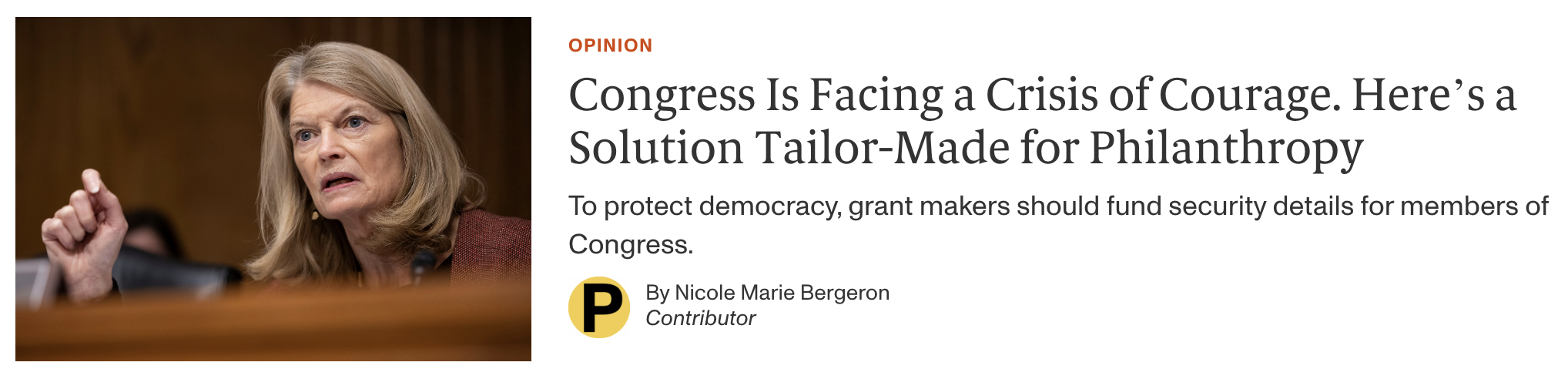
Congress Is Facing a Crisis of Courage. Here's a Solution Tailor-Made for Philanthropy.
The Chronicle of Philanthropy · June 12, 2025
Funders talk a lot about defending democracy. But they often skip over the real problem.
Beneath the swirl of continuous crises — from immigration to higher education to the courts — is a deepening meta crisis: a collapse of courage, clarity, and critical thinking. And nowhere is that collapse more visible — or dangerous — than in Congress.
Threats against congressional members, family, and staff have set records in recent years, climbing to 9,474 in 2024, according to data released by the United States Capitol Police. Just last month, a man who made antisemitic death threats against Democratic Senator Jacky Rosen of Nevada, was sentenced to four years in prison.
In April, Republican Senator Lisa Murkowski of Alaska spoke the quiet part out loud. “We are all afraid,” she told a room of Alaska nonprofit leaders, naming a truth many suspect but few admit. Members of Congress aren’t just worried about losing elections, they’re afraid for their own safety and for their families. The threat is real, and it’s reshaping how public service is done.
Former Republican Representative Liz Cheney of Wyoming has publicly described receiving a Capitol Police security detail due to threats she faced after voting to impeach President Trump during his first term and again after serving as a leader of the House January 6 committee. In her memoir “Oath and Honor,” she writes that fear for personal and family safety shaped the decisions of several of her colleagues, making it clear that intimidation was real and consequential.
The Capitol Police are authorized to protect all members of Congress and their families, but in practice, only those in leadership or facing credible threats receive full-time details. Expanding that coverage typically requires congressional approval and additional funding — steps that are politically fraught and often delayed.
Instead, most congressional members must use personal or campaign funds to address safety needs. Former Republican Senator Mitt Romney of Utah and Democratic Representative Eric Swalwell of California have both publicly acknowledged paying for their own protection. In March, the Los Angeles Times reported the Swalwell has received “countless death threats against himself and his family” and has been “physically accosted.” He said he has spent more than $1 million on personal security — a sum few in Congress could afford.
This climate of fear isn’t theoretical — it’s distorting the moral landscape of governance.
Reducing the Threat
Here’s my call to action for philanthropy: If fear is shaping decisions, let’s reduce the threat behind it. Let civil society step in — not with judgment, but with infrastructure. Let’s fund safety for members of Congress, so they can do their jobs without concern for their physical wellbeing.
Yes, the federal government should already be doing this. But even if Congress agrees in principle, formalizing and funding a solution could take months or longer — and the threats exist now.
This isn’t about partisanship. It’s about protecting the capacity to lead. Every senator and congressional representative should have access to 24/7 professional protection. Whether and how their families are included in that protection should be up to them.
So how could this work? A pooled, bipartisan donor fund could contract with independent, professional security providers. These wouldn’t be private police forces, but licensed firms coordinating with law enforcement, such as those used to protect athletes, celebrities, senior executives, and other high-profile individuals whose visibility or responsibility puts them at risk. Members who opt in could receive home security assessments and systems; protection while traveling or at public events; and optional support for coordinating family safety plans and emergency response, such as evacuation logistics and crisis communications.
The design must be voluntary, flexible, and bipartisan. The goal isn’t to reward certain congressional members, but to remove fear as a structural barrier to leadership.
Philanthropy can also offer more than just funding. Grant makers often help build the structure around complex or sensitive projects. In this case, that might include bringing in legal and ethical advisors, working with security professionals to shape responsible protocols, or setting up systems that make coordination with law enforcement possible.
Foundations have shown up in this way before, helping create rapid response systems in times of public strain when the stakes are high and the logistics are complex. For example, after hurricanes in Texas and Florida, and wildfires in California[AS1] , grant makers funded everything from mobile clinics and emergency housing to coordination hubs and logistics support when government systems were overwhelmed.
The playbook already exists — civil society fills gaps wherever institutions falter. This is simply a new frontier: safety as a precondition for courage.
Fixing the Boiler
I’ve sometimes used what I call the “mechanical room” approach to describe a certain kind of philanthropy that starts with funding the essentials. If students can’t learn because the boiler doesn’t work — if they’re too hot in summer or too cold in winter — then fixing the HVAC comes first. We start with what makes everything else possible. Then, sure, build the atrium, write the curriculum, do the real work of learning. If fear is now the broken boiler in Congress, then safety is where we begin.
Courage always carries costs: public criticism, political fallout, even the loss of power. That’s to be expected. But fear of violence isn’t an honorable cost — it’s a breakdown of the system.
Ensuring that all members of Congress are safe from violence doesn’t address root causes such as escalating rhetoric or broader symptoms like polarization. But it does remove one specific barrier: the fear that is actively blocking moral leadership and preventing elected officials from speaking out, casting difficult votes, or acting on conscience. That makes it worth investing in.
This isn’t a program I’m launching. It’s a possibility I’m naming. Others are better positioned to build this. But someone needed to say it — and it can be acted on quickly, ethically, and with bipartisan support.
If we want moral clarity to return, we must create the conditions where it’s possible. If we let fear harden into the structure of democracy, we shouldn’t be surprised when silence becomes the norm.
Let’s meet fear with resolve, invest in courage, and see what becomes possible when the threat no longer owns the room.
Nicole Marie Bergeron is an attorney and philanthropic advisor who serves on the boards of Sojourners, the Jacques M. Littlefield Foundation, Moonshot edVentures, and the Aslan Housing Foundation.